

SUPRAESPINATUS TENDINITIS
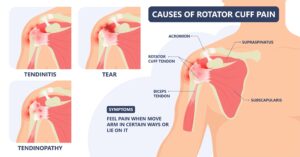
A tendinopathy is a pathological process of the tendon in which there might be inflammation. The following examples exist:
- Supraspinatus tendinitis: when there is inflammation in the tendon
- Tendinosis: degeneration of the tendon
- Calcific tendinitis: accumulation of calcium in the tendon. This makes the space where the tendon goes reduce, and therefore it compresses it.
The Shoulder Joint Complex (SJC) is formed of the following articulations:
- Sterno-clavicular
- Acromioclavicular
- Glenohumeral
- Scapulothoracic
The SJC has movement in the three planes and axis: flex/stretch, internal/external rotation, abduction/adduction.
Which is the supraspinatus muscle?
Supraspinatus is a muscle that extends itself from the supraspinous fossa of the scapula all the way to the humerus.
It forms part of the muscle set of the “manguito de los rotadores”.
The supraspinatus tendinopathy is an inflammation or attrition of the tendon caused by repetitive movements of shoulder elevation

What is el “manguito de los rotadores”?
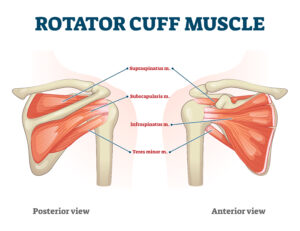
It is the muscle set that has its origin in the scapula and inserts itself in the humerus (trochyn and trochyter) and it provides stabilities to the SJC:
- Supraspinatus: Performs the first few degrees of lateral raising movement of the arm with respect to the body.
- Infraspinatus: Externally rotates the arm.
- Teres minor: Externally rotates the arm.
- Subscapularis: Internally rotates the arm.
75% of tendinopathies that occur in the shoulder is supraspinatus tendonitis, since it is a muscle that tends to get overloaded in athletic, work, or day-to-day activities.
What causes a tendinopathy?
- Repetitive movements: especially in movements over the shoulder plane.
- Sedentarism: The lack of force to the muscle causes instability of the SJC.
- Vascular: if a blood deficit exists, the tendon won’t be well-nourished and it will be more likely to get damaged.
- Deficit or excess of mobility and SJC muscle strength:
- If the joints that make up the SJC do not have good mobility, stiffness exists, or the muscle works incorrectly due to the lack of strength, it can cause damage to other structures.
- If hypermobility of the SJC exists, this can be caused by a lack of stability of the zone causing it to work incorrectly.

To avoid injuries in the “manguito rotador” you must have good motor control of the SJC muscle, a good joint mobility and muscle flexibility. A tendon can get damaged by overstimulation, and by the lack of tonification, which is what brings stability to the musculature.
What do I need to do to not continue damaging my tendon?
- Have a toned musculature: The tendons can bear with big loads, but just like every other part of the body, we have to get them used and prepare our muscles to that sort of exercise. Progressive training: slowly increase the load.
- Avoid sedentarism: Improve the strength of the shoulder muscles.
- Start playing a sport in a progressive way: When you start a physical activity you must have strong and balanced muscles. The best prevention is being in good condition.
- Avoid repetitive movements or postures that go above the shoulder: If we stretch the muscle too much or we hold a bad posture, it generates an excess of load that the tendon can’t bear.
Symptoms
- Pain: It is the most common symptom. It happens in the lateral and anterior zone of the shoulder before getting to the elbow.
- Tendinitis: Pain usually occurs at night and first thing in the morning.
- Tendinosis: Pain occurs when moving your arm away from your body.
- Supraspinatus tendinitis: Sudden pain when you are about to start a movement.
- Limitations of the movement of the elbow: especially when lifting the shoulder, this is due to the pain.
- Loss of strength and muscle capacity

How do I know if I have tendinitis?
It is important to have a good diagnostic to determinate the treatment, therefore, it is recommended to get a medical test done:
- Diagnostic for the image: echography, magnetic resonance, etc.
- Specific therapeutical tests which evaluate every muscle of the shoulder.
The supraspinous test is the following:
- JOBE TEST: the test will be positive if there is pain or loss of muscle mass.
Physiotherapy treatment:
- Specific work: on the pain zone and the affected muscle
- Dry-needling
- Functional exercises
- Muscular support
- Specific stretching

- Global work:
- Try to avoiding the repetitive movements that have brought you the problem.
- Also work the muscles that surround it.
- Exercises of the stabilizing musculature and shoulder.
- Gain mobility of the shoulder and scapula.
No Comments